01
Teacher intent stays natural
A teacher can ask for a Year 11 Macbeth deck, a worksheet, a parent email, or marking support in normal language. The runtime classifies the task family before any artifact builder runs.
AI Deployment Engineer / FDE portfolio
BSc Computer Science finalist in London, graduating July 2026 and on track for a First. I build agentic systems from messy workflow discovery into deployed runtime, eval gates, rollback thinking, and production-shaped iteration.
worksheet-core-generation
mechanical: pass
quality: needs_judgement
drift_status: pass

why it matters
Generated files can pass technically and still need teacher-quality review before promotion.The story is not years of employment. It is dense founder/operator reps in AI workflow design, deployment, evals, runtime debugging, and direct user evidence.
TeachClaw showcase
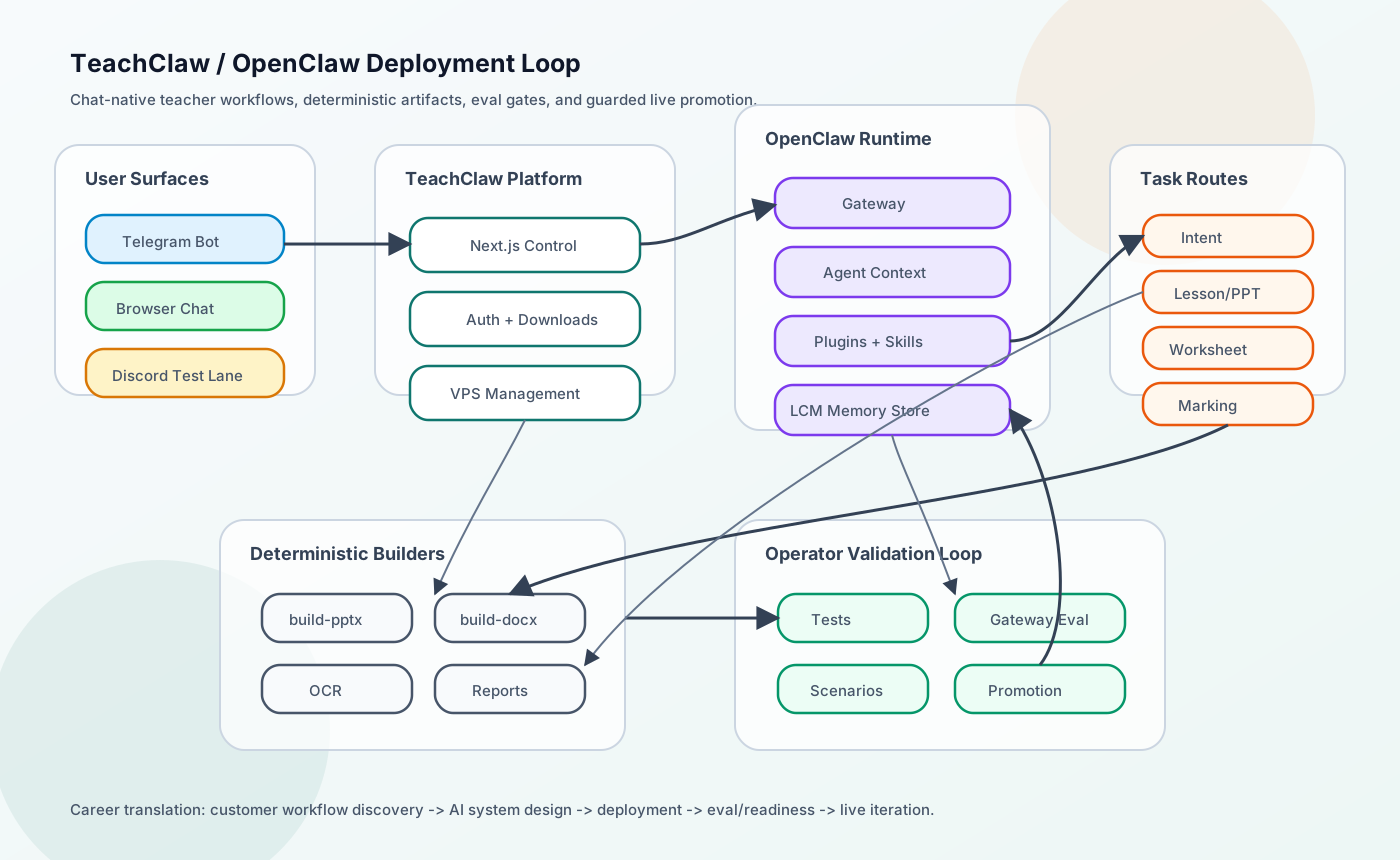
TeachClaw turns teacher intent into finished school work: decks, worksheets, marking support, feedback, and memory-aware planning. The interesting engineering is the layer around the model: routing, deterministic artifact builders, trace checks, drift checks, and quality gates.
A teacher can ask for a Year 11 Macbeth deck, a worksheet, a parent email, or marking support in normal language. The runtime classifies the task family before any artifact builder runs.
LLM output is not the finished product. For file-producing routes, the agent has to call deterministic builders like build-pptx.py or build-docx.py and return a real path, not a vague promise.
Scenario packs assert route logs, expected output type, file extension, max tool calls, forbidden leakage, memory boundaries, and whether human quality judgement is still required.
The promotion summary captures commit SHA, built artifact hash, loaded runtime hash, scenario outcomes, risks, and whether live approval is safe. A mechanical pass can still be held back for teacher-quality review.
{
  "id": "ppt-macbeth-ambition-analysis",
  "family": "powerpoint",
  "goal": "Prove the English exam-analysis PPT lane",
  "expected_output": {
    "kind": "artifact_path",
    "extension": ".pptx"
  }
}{
"required_route_log_substrings": [
"route=hybrid_staged"
],
"required_exec_patterns": [
"build-pptx.py --file ... .pptx"
],
"max_exec_calls": 4
}marking-single-image:
mechanical: pass
quality: needs_judgement
worksheet-core-generation:
mechanical: pass
quality: needs_judgement
live checkpoint:
explicit approval requiredI am earlier-career by title, but the work shape is already close to AI deployment: user workflow, LLM system, runtime, evals, launch proof, and iteration.
I am not claiming ten years of enterprise delivery. I am claiming unusually direct founder/operator reps in the exact loop FDE and AI deployment teams care about: understand the workflow, build the AI path, ship it, debug it, and turn failures into evidence.
These are public-safe writeups. They avoid private teacher data, secrets, internal IPs, and TeachClaw source code.
Chat-native AI assistant for UK teachers with document generation, marking support, teacher memory, VPS deployment, and eval-gated release discipline.
Operator cockpit with gateway sessions, plugins, LCM memory, local validation lanes, promotion summaries, and runtime drift discipline.
Full-stack synthetic health data licensing prototype using Next.js, Express, Prisma/PostgreSQL, IPFS, and Story Protocol testnet flows.
Telegram-based electrician assistant for notes, voice input, structured extraction, certificates, reports, quotes, invoices, and RAMS.
OpenClaw-backed concierge demo for jewellery enquiries, safe customer replies, staff briefs, dry-run channel contracts, and local runtime proof.
Public FastAPI proof with retrieval, eval runs, SQLite persistence, API-key write protection, audit events, readiness gates, Docker, and CI.
TeachClaw maps cleanly to AI deployment work: user workflow surfaces, a platform layer, an agent/runtime layer, deterministic builders, and a validation loop before live promotion.
Fast links for applications, profile cleanup, and technical proof.